
Update - September 22, 2020
Why These Two Stocks Were up Yesterday
The headline writers are busy this week.
Politics… the pandemic… and a stock market rout.
I could wear this keyboard out with all that’s on my mind and all I think you must ponder. But the pundits and the “experts” in the world of 24-hour news have most of it covered. Pick a channel… pick your party… and get filled with all the opinions you can handle.
But there’s one story that’s not in the news… or at least the full breadth of the idea hasn’t hit the headlines yet.
Over the weekend, a series of investigative journalists went after the nation’s big banks. They “revealed” how bad actors are using our banking system to launder money and feed their operations.
It’s nothing new.
Many of these accusations go back years, if not decades. And worse, the folks in charge of actually enforcing the laws have long known about what’s happening.
That’s because, after all, banks are forced to tell them.
The reporters admit as much. They detail how thousands of “suspicious activity reports” are filed by banks and sent to regulators each year. Very few get acted upon.
The reports showed how Russian insiders used Barclays to avoid sanctions… how JPMorgan Chase and others moved money for the former mayor of a major city in Kazakhstan, even though he had a warrant for his arrest… and how HSBC allowed one client to move $15 million even though their business was barred in three states.
Like I said, this is nothing new.
It’s more of a failure of the regulators than a failure of banks that are making countless transactions each day.
But it does serve as another push in the direction for something I’ve written about a lot… the death of cash.
Other Motives
Surely, the many pieces that were published in the last 48 hours were written with more than just halting global crime in mind. They were written as 1) another attack on the big banks and 2) another cry for more government control of our money.
Clearly, the folks behind the news are pushing for the death of cash. Barron’s even published an article yesterday with a headline that declared, “Cash Is Dead.”
The folks behind these pieces clearly want a system that allows regulators to monitor the movement of money… without the banks serving as a high-profit middleman.
Piece by piece, they’ll get it.
That’s why – despite the carnage on Wall Street yesterday – a stock I highlighted in my “death of cash” reporting was well into the green.
Shares of PayPal (PYPL) were up by over 3% throughout the day.
The stock is up by more than 110% in the last two years. And it’s far from done. The transformation to a fully digital economy still has a way to go.
It’s no coincidence shares of PayPal were up while so much of the market – led by the big banks – was down.
If you haven’t read the reports we’ve published on the death of cash, head to the site now to check them out.
Another stock that was up yesterday was Logitech (LOGI), the work-from-home play that signaled its enduring strength by buying back millions of dollars’ worth of its own shares.
Shares were up by as much as 2.5%.
It makes sense. As the coronavirus has European regulators once again tightening the reins and fears of the same creep across the Atlantic, the work-at-home economy is gaining fresh steam.
As I’ve said many times before, Logitech is an ideal way to play the action.
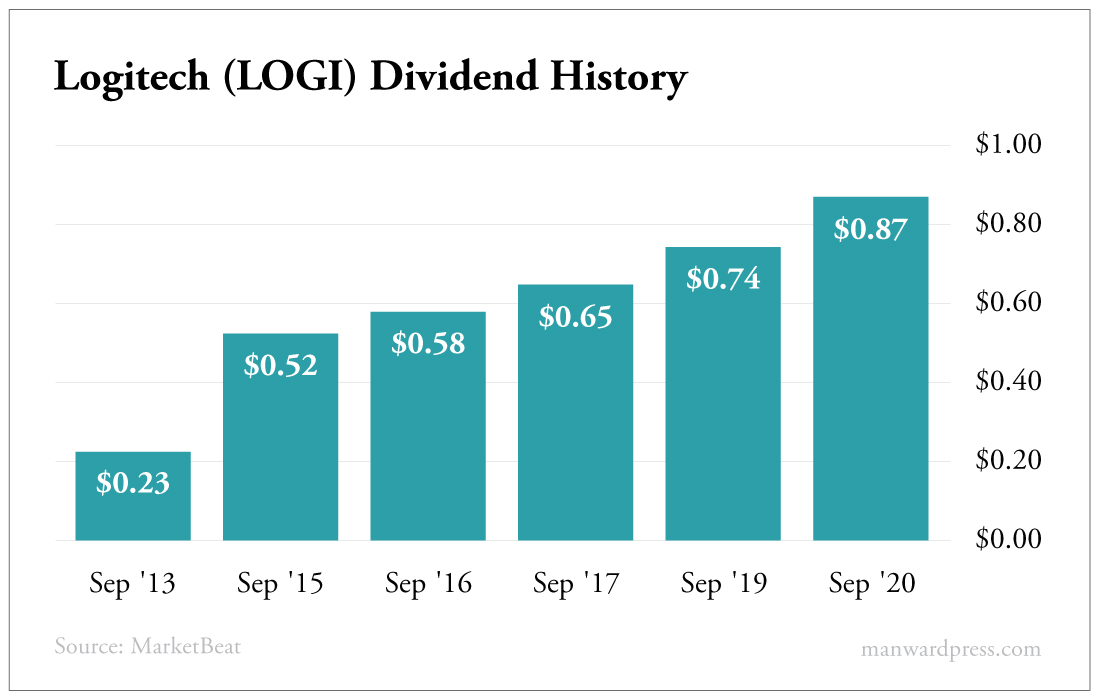
Sales have been strong enough to convince management to, once again, raise the company’s dividend. It just got boosted 10% above last year’s payout – rising to $0.87 per share (a yield of 1.2%).
 But remember, this isn’t just an income-generating, work-at-home play. I first uncovered it by studying one of the most powerful forces in the market right now… buybacks.
Logitech was one of the rare companies promising to continue buying back their shares this spring.
The mere notion of a buyback announcement (which is often tucked deep in a company’s quarterly or annual report) should serve as a beacon of light drawing in weary investors. It’s a surefire sign that a company has a strong financial foundation and is committed to increasing shareholder value.
The latest numbers show that buyback activity is far from the pace we saw (and enjoyed) last year, but it’s not as anemic as many folks believe.
So far this year, we’ve seen $86 billion in buyback spending. This time last year, the number was $165 billion.
PayPal, by the way, is responsible for more than a billion dollars’ worth of that activity.
Clearly, if we find the companies that are buying back their own shares, we know we’ve found companies that are likely treating shareholders quite well – even on a day like yesterday.
I’ll keep telling you about the best of them.
Be well,
Andy