
Update - May 17, 2022
The Great Reset
Breaking news… The Federal Reserve acted too late.
That’s a real shocker, right?
Inflation is soaring. Stocks are suffering. And Ben Bernanke is stating the obvious as he hits the mainstream money press to peddle his new book.
“I think in retrospect, yes, it was a mistake,” he said of his successor’s decision to act later rather than sooner.
It almost makes you want to cuss, right?
Almost.
I covered a lot of what’s happening in last week’s “town hall” meeting. You can view a recorded version here. I won’t rehash a lot of the data here.
But there is a chart from our friends over at Yardeni Research that I want you to see today.
It helps add some context to the latest downturn. It shows, dare I say it, that things aren’t as bad as they look.
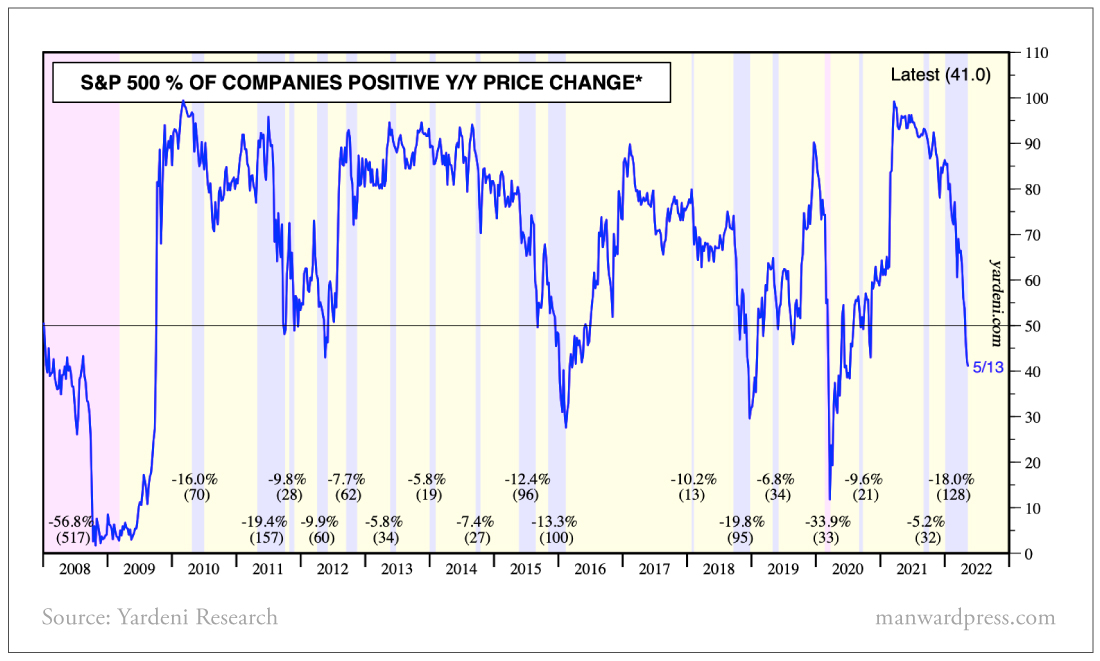
There’s a lot going on in this chart, so I’ll explain it briefly. What it’s showing us is the percentage of companies within the S&P 500 that have a positive year-over-year price change.
In other words, from last May to today… it shows us how many companies have seen their share prices rise.
Yes, the markets have sold off, but compared with previous large downturns, the pain isn’t all that terrible. As the numbers near the bottom of the chart show, we’re down about 18% in 128 days (the days are in parentheses), but 41% of the S&P is still positive compared to where it was last year.
The chart shows how high things went (the product of printing $5 trillion in easy money) and how the market’s natural forces flushed that excess out of the economy.
We started in sky-high territory… but we’re ending in a healthy spot.
That’s the key. It’s quite encouraging.
No, giving up gains is never fun. But for the first time in a long time, I’m starting to screen for valuations. Finally, a company’s price-to-earnings ratio means something again. And old-school fundamental analysis is again proving to bring context to the decision-making process.
That’s healthy. That’s the way it should be.
As I’ll describe in the next monthly issue, it means the market needs to put new weight on some older metrics, and we need to tweak our strategy a bit as interest rates rise. Speculative assets are no longer getting the free-money premiums they got when the printing presses were red-hot. On the flip side, though… income is coming back to the market. And yield doesn’t have to come only from high-risk plays.
For many investors, that result is refreshing.
As the chart above shows, it’s rarely fun getting to that place… but the payoff tends to reward those with the patience to endure it all.
We’re in a period of flux.
Ultimately, it’s what we needed.
We will continue to buy, taking advantage of good valuations and great opportunities.
This “reset” will treat us kindly.