
A New Way to Trade: Why Share Price No Longer Matters

I’ve been leading folks to intriguing moneymaking opportunities for a long time.
And if I had to pick just one thing that frustrates new investors the most… it would be price.
I get it. When you’ve got just a few hundred or a few thousand dollars to invest, nobody wants to put it all into a single share of a hot company.
It’s risky and, frankly, no fun.
But too many folks take this idea too far. That’s why penny stocks – which can be quite dangerous if you don’t know what you’re doing – got so popular.
With stocks that trade for just a few cents, investors can get hundreds of shares in dozens of companies.
But there’s a reason good stocks are “expensive” and lousy stocks are cheap.
You get what you pay for.
But that’s no longer entirely true.
Wall Street Is (Finally) Open to All
Thanks to some fresh innovation on Wall Street that I am quite fond of, price no longer matters. Whether you’re starting out with $10 or $10 million… you can now buy the same stocks.
Shares of Berkshire Hathaway (NYSE: BRK-B) are famously expensive. On Friday, November 22, 2019, for example, a single share of the billionaire-making stock would have cost you more than $325,000.
Only the rich could get in.
But that’s all changed.
On Monday, November 25… just hours after many folks happily plunked down hundreds of thousands of dollars for a share of Berkshire… you could’ve gotten a stake in the company for just a buck.
Fractional shares had become a reality on Wall Street.
Interactive Brokers was one of the first firms to kick off the trend, in late November 2019, and it’s been exploding in popularity ever since. Some small brokers tell us that up to 50% of their trades each day are now for fractional shares.
The way it works is quite simple.
As an investor, all you need to do is make a trade using your brokerage’s platform. It’s easy. You can even do it on your phone.
Here’s what it looks like using Fidelity’s smartphone app…
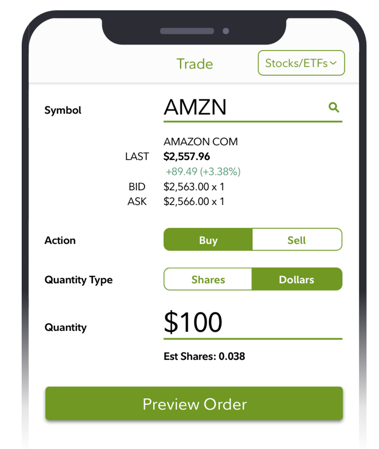
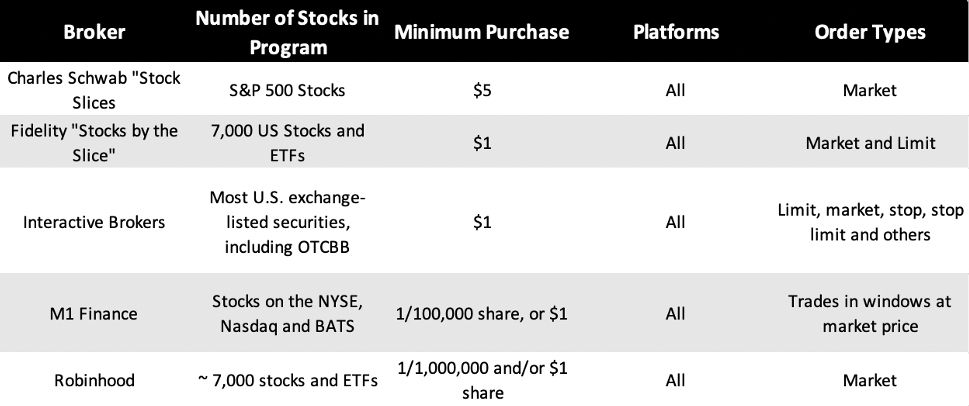
Each brokerage platform boasts slightly different options.
Interactive Brokers, for instance, requires a minimum investment of $1 and offers a wide array of limit orders.
Charles Schwab requires a $5 minimum purchase and offers only market orders.
(See the end of this report for an up-to-date list of popular brokerages that offer the service, including their minimum prices and any limitations.)
For most investors, these nuances aren’t major, but they are worth studying before you pick a brokerage.
A Whole New World
Once you place your trade, your investment is treated just as if you owned a full share. If the stock goes up by 10%… your stake goes up by 10%. If the stock goes down… your stake goes down.
It’s even true with dividends. If a stock pays a dividend of $1 per share, and you own, say, a tenth of a share… you get a $0.10 payout.
It’s very simple.
What’s not simple are the doors this new investing option opens.
This is huge.
Fractional shares make smart, modern diversification possible for even the smallest of investors.
Think about the popular FAANG trade, for example.
It requires a stake in…
- Facebook (Nasdaq: FB), which trades for around $340
- Apple (Nasdaq: AAPL), which trades for around $150
- Amazon (Nasdaq: AMZN), which trades for more than $3,400
- Netflix (Nasdaq: NFLX), which trades for just over $600
- Google’s parent company Alphabet (Nasdaq: GOOG), which trades for more than $2,800.
Just to buy a single share of all five would cost nearly $7,300. That’s a lot for five much-hyped stocks… And it’s flat-out impossible for a novice investor, who may have just $1,000 to put toward their retirement.
With fractional investing, though, that same investor can now put just $100 into a FAANG trade… and spread the rest across an array of diversified stocks.
Like I said, it’s changed the world of investing. It’s democratized Wall Street and taken share price out of the equation.
That’s great… because now we can focus on buying stocks with the most value… not just the ones with the lowest price tag.
If you’re new to investing… don’t have much to invest… or just want to pick up a slice of some super-expensive stocks… find a brokerage that offers fractional investing.
The list is growing fast.
It’s a welcome innovation. Price no longer matters.
Note: We’ve found that readers tend to buy the stocks in these special reports at different times. Keep in mind that we may have taken profits or stopped out of a recommendation by the time you read this report. Please refer to the current portfolios for the most up-to-date recommendations.
© 2026 Manward Press | All Rights Reserved
Nothing published by Manward Press should be considered personalized investment advice. Although our employees may answer your general customer service questions, they are not licensed under securities laws to address your particular investment situation. No communication by our employees to you should be deemed as personalized investment advice. We allow the editors of our publications to recommend securities that they own themselves. However, our policy prohibits editors from exiting a personal trade while the recommendation to subscribers is open. In no circumstance may an editor sell a security before subscribers have a fair opportunity to exit. The length of time an editor must wait after subscribers have been advised to exit a play depends on the type of publication. All other employees and agents must wait 24 hours after publication before trading on a recommendation.
Any investments recommended by Manward Press should be made only after consulting with your investment advisor and only after reviewing the prospectus or financial statements of the company.
Protected by copyright laws of the United States and international treaties. The information found on this website may only be used pursuant to the membership or subscription agreement and any reproduction, copying or redistribution (electronic or otherwise, including on the world wide web), in whole or in part, is strictly prohibited without the express written permission of Manward Press, 14 West Mount Vernon Place, Baltimore, MD 21201.
January 2021.